> ## Documentation Index
> Fetch the complete documentation index at: https://memory.mahimai.ca/llms.txt
> Use this file to discover all available pages before exploring further.
# Introduction
> Long-term memory for LiveKit voice agents, backed by PostgreSQL and pgvector.
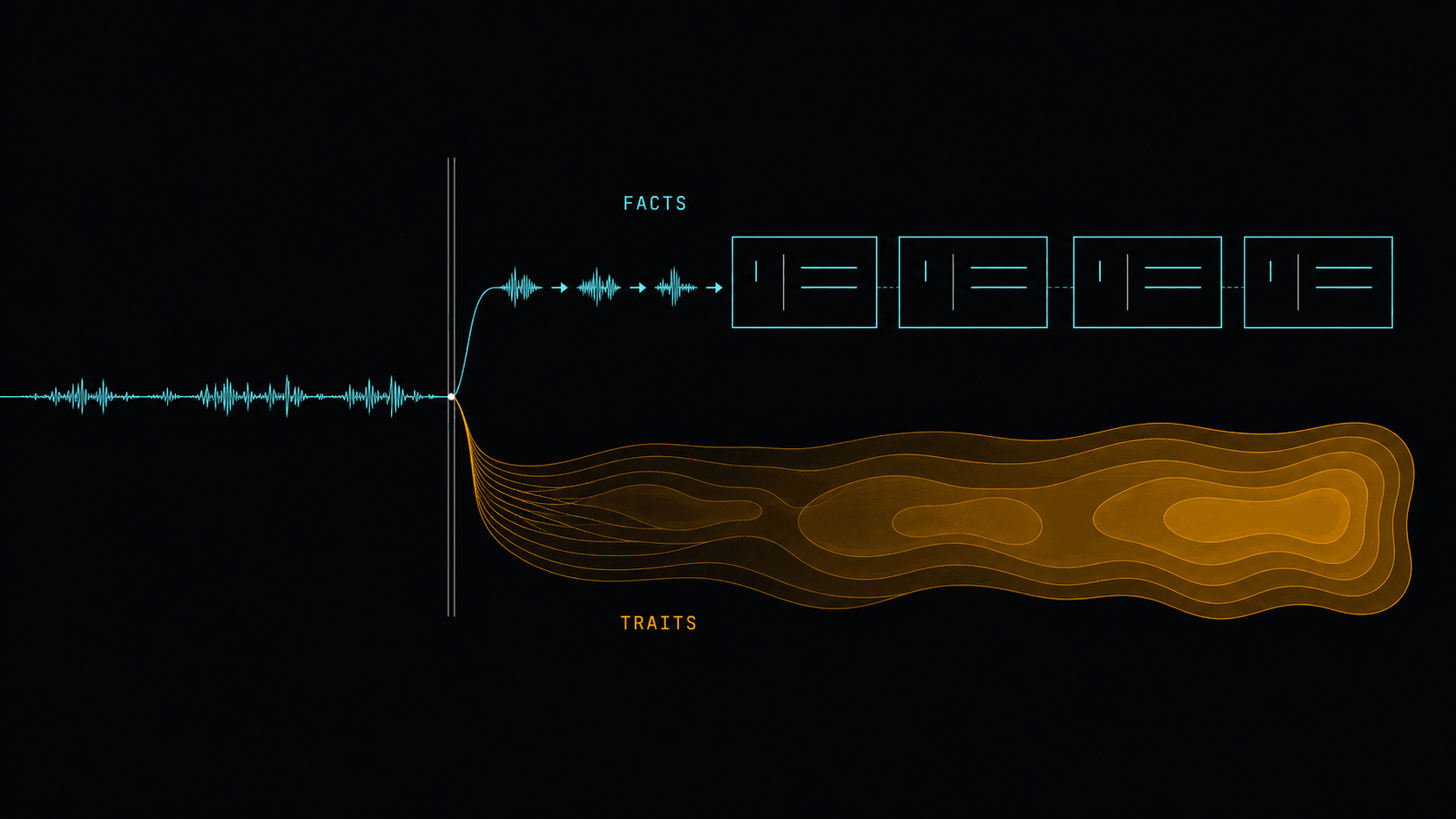 Every turn a caller speaks splits two ways.
**Facts** are discrete and retrievable. They are allergic to shellfish. Their manager is Priya.
They adopted a beagle in August.
**Traits** are continuous and never stated outright. They get anxious before design reviews.
They want the conclusion before the reasoning.
Most memory layers store only the first kind. That is why agents that "remember" still sound like
they are reading your file back to you. VoiceMemory stores both and injects them differently:
facts the agent may repeat, traits it may only be shaped by.
## What you get
A caller mentions a shellfish allergy on Monday. On Friday they ask about the prawn curry and
the agent already knows.
192 ms p50 retrieval, and 93% of that is one OpenAI round trip that prefetching hides.
`livekit-agents`, `openai`, `psycopg`. No torch, no local models, no multi-gigabyte image.
`tenant_id` on every table and every query, with optional PostgreSQL row-level security.
## How it works
**Reading** happens inside the voice turn and makes no LLM call. The query is embedded once,
classified into one of seven life domains, narrowed to those candidates, ranked in pgvector, and
scored. Relevant traits are fetched concurrently.
Retrieval also starts speculatively on interim transcripts, while the caller is still speaking, so
the network round trip overlaps with speech instead of delaying the reply.
**Writing** happens after the turn and never sits between the caller finishing and the agent
speaking. One extraction call pulls out facts, an emotion and traits together. A second call
resolves those facts against what is already stored, deciding add, update, delete or nothing.
Scoring is deliberately two-part. `base_score` is the raw cosine and decides the ordering.
Lexical and date bonuses only **rescue** a buried memory into the result set; they never
displace something that was semantically relevant to begin with.
## Limitations
Stated here rather than buried, because they decide whether this fits your case.
The extraction model reads what was said. There is no prosody analysis, no acoustic emotion,
no voiceprint and no speaker identification. Text catches "I'm frustrated". It cannot catch a
flat "fine" said bitterly. Upstream VoiceMem ships those features; this plugin does not,
because they require torch, funasr and modelscope.
Injecting memory changes the turn's chat context, so LiveKit's equivalence check fails and it
cancels the speculative generation it had already started. Preemptive generation is **on by
default**, so unless you turn it off you pay for a discarded LLM call every turn. The plugin
logs a warning once at startup if you have not.
"next week" expands to `August 31, 2026`, matching how the extractor writes dates. Other
languages are returned unchanged, so time-scoped retrieval falls back to whatever dates
happen to appear in the memory text.
They live in a dedicated `voicemem` schema so they never collide with yours. The 0.x schema
is not stable between minor versions.
`on_user_turn_completed` does not fire on those turns, so memory is neither injected nor
ingested.
## Start here
Install, migrate, and wire it into an agent. Ends with a transcript proving
it remembers across sessions.
Every `Config` field, the Python API, the four protocol seams, and the CLI.
Questions, and what people are building with it.
Source, issues, and the changelog.
## Attribution
VoiceMemory is derived from [VoiceMem](https://github.com/xzf-thu/VoiceMem) (Apache-2.0), a
separate project by different authors. The prompt templates
originate from [mem0](https://github.com/mem0ai/mem0) (Apache-2.0). See `NOTICE` and
`CHANGES-FROM-UPSTREAM.md` in the repository.
Not affiliated with, endorsed by, or sponsored by LiveKit, the VoiceMem authors, or mem0.
Every turn a caller speaks splits two ways.
**Facts** are discrete and retrievable. They are allergic to shellfish. Their manager is Priya.
They adopted a beagle in August.
**Traits** are continuous and never stated outright. They get anxious before design reviews.
They want the conclusion before the reasoning.
Most memory layers store only the first kind. That is why agents that "remember" still sound like
they are reading your file back to you. VoiceMemory stores both and injects them differently:
facts the agent may repeat, traits it may only be shaped by.
## What you get
A caller mentions a shellfish allergy on Monday. On Friday they ask about the prawn curry and
the agent already knows.
192 ms p50 retrieval, and 93% of that is one OpenAI round trip that prefetching hides.
`livekit-agents`, `openai`, `psycopg`. No torch, no local models, no multi-gigabyte image.
`tenant_id` on every table and every query, with optional PostgreSQL row-level security.
## How it works
**Reading** happens inside the voice turn and makes no LLM call. The query is embedded once,
classified into one of seven life domains, narrowed to those candidates, ranked in pgvector, and
scored. Relevant traits are fetched concurrently.
Retrieval also starts speculatively on interim transcripts, while the caller is still speaking, so
the network round trip overlaps with speech instead of delaying the reply.
**Writing** happens after the turn and never sits between the caller finishing and the agent
speaking. One extraction call pulls out facts, an emotion and traits together. A second call
resolves those facts against what is already stored, deciding add, update, delete or nothing.
Scoring is deliberately two-part. `base_score` is the raw cosine and decides the ordering.
Lexical and date bonuses only **rescue** a buried memory into the result set; they never
displace something that was semantically relevant to begin with.
## Limitations
Stated here rather than buried, because they decide whether this fits your case.
The extraction model reads what was said. There is no prosody analysis, no acoustic emotion,
no voiceprint and no speaker identification. Text catches "I'm frustrated". It cannot catch a
flat "fine" said bitterly. Upstream VoiceMem ships those features; this plugin does not,
because they require torch, funasr and modelscope.
Injecting memory changes the turn's chat context, so LiveKit's equivalence check fails and it
cancels the speculative generation it had already started. Preemptive generation is **on by
default**, so unless you turn it off you pay for a discarded LLM call every turn. The plugin
logs a warning once at startup if you have not.
"next week" expands to `August 31, 2026`, matching how the extractor writes dates. Other
languages are returned unchanged, so time-scoped retrieval falls back to whatever dates
happen to appear in the memory text.
They live in a dedicated `voicemem` schema so they never collide with yours. The 0.x schema
is not stable between minor versions.
`on_user_turn_completed` does not fire on those turns, so memory is neither injected nor
ingested.
## Start here
Install, migrate, and wire it into an agent. Ends with a transcript proving
it remembers across sessions.
Every `Config` field, the Python API, the four protocol seams, and the CLI.
Questions, and what people are building with it.
Source, issues, and the changelog.
## Attribution
VoiceMemory is derived from [VoiceMem](https://github.com/xzf-thu/VoiceMem) (Apache-2.0), a
separate project by different authors. The prompt templates
originate from [mem0](https://github.com/mem0ai/mem0) (Apache-2.0). See `NOTICE` and
`CHANGES-FROM-UPSTREAM.md` in the repository.
Not affiliated with, endorsed by, or sponsored by LiveKit, the VoiceMem authors, or mem0.